Yes that’s me!
听不懂?比较喜欢中文?这里有中文版哦~
Do you think it’s applicable to individuals too?
I just read this on the New York Times, I guess it’s not surprising that frequent hardship like famine, war etc makes a society more resilient. Just like ecosystems that go through frequent disturbances become the most resilient too.
But think about people around you, do you think some individuals who survive frequent hardship become the strongest to bounce back, compare with those who have had a smooth life?
What are the other deciding factors?
I’m looking at this as a school counsellor. I work with kids who come from very privileged background, whose, should they fail all their high school final exams, parents could probably open a university in a big city just for them. But I also work with kids who come from very underprivileged backgrounds, who are here on scholarships. They are all in the same school. Often people question why the world is so unfair. One could look at their classmate every day and have all sort of “how if” in their mind.
Which of these groups might be more resilient in face of hardship? (Obviously there are probably many other factors that play a part here)
I’m also looking at this as a parent (a very new one). How do you think we could raise kids who are more resilient? Who can bounce back after falls? Kids who are confident and resilient?
Hello! Hope you are all well reading this? This is a blog that I’ve been updating regularly since 2013. What has made Hui Bee disappeared for so many months?
Well, I’m alive, in fact, contented and gratified with where I am at this point of my life. I’ve been thinking about my blog and wanting to write an update but haven’t got a chance to sit down and do so.
The answer is, I have a baby. He is now 8.5 months old. So I guess that explains most of the things. I’ve returned to work in January this year, but haven’t resumed my private work as a psychotherapist, coach and Hypno-CBT supervisor. To be honest, I don’t foresee myself resuming those till much later this year.
I’ve never thought that I’d become the kind of mother I have become. I miss my baby on days that I have to be away for work for a few hours. The thing is I’ve always been quite a self-centred person all my life, now this self-less situation, this putting-him-before-me-and-sometimes-forgetting-my-own-needs kind of situation is very very new to me. Every day I’m learning, with him, from him.
So really, just a quick update that I’ve been doing good, (or I’m still alive!), and if you’d like to reach out for any quick chat or general guidance, please send me an email via hello@huibee.com. I accidentally lost my malaysia registered cell phone numbers unfortunately… So do NOT whatsapp or call the numbers anymore.
I will slowly come back to writing and updating my blog. In fact I have so much to share!! I just need to come back to writing… (without being so obsessed about my baby!)
This is probably the best book I’ve read/listened to in the past two years and would highly recommend anyone to read this.

It’s not a conventional self-help book, with the author telling you how to solve the problem (in this case – regaining your focus), what he has tried, what research says would work, nothing like that.
He does tell you as an individual what we can do to possibly prolong our focus, like for example, getting into a flow state (being passionate about ONE thing that’s meaningful to you), having enough sleep by following your body and nature (not the clock and manmade routines), changing relationship with your devices, reading and especially reading fictions (something that I’ve given up for a long time but been longing to come back to it yet I couldn’t find the excuse!), and letting the mind wonder, without any device.
But the fact that the title is “Stolen” focus, that indicates that it really just isn’t about what we can do. The book goes on to discuss how the bigger environment, societal and education systems around us have been preventing us from doing so (e.g. technology and social media algorithms), yet we are blaming ourselves when we fail to sustain our attention for a prolong period of time.
Here is a pretty good summary from the author towards the end of the book:
When adults notice that children and teens seem to be struggling to focus and pay attention today, we often say it with a wary and exasperated superiority. The implication is, “look at this degraded younger generation, aren’t we better than them? Why can’t they be like us?”
But after learning all these, I think about it very differently – children have needs, and it’s our job as adults to create an environment that meet those needs.
In many cases in this culture, we aren’t meeting those needs. We don’t let them play freely, we imprison them in their homes with little to do except interact via screens. And our school systems largely deadens and bores them. We feed them food that causes energy crashes, contains drugs-like addictives that can make them hyper, and doesn’t contain the nutrients they need. We expose them to brain destructing chemical in the atmosphere.
It’s not a flaw in them, that as a result they are struggling to learn attention, it’s a flaw in the world we built for them.
I stumbled upon this article by the New York Times a couple weeks ago, and have been thinking about it. I do want to apologise for not updating my blog as regularly as I used to, I will probably write a personal piece to share why and what has been happening in my private life.
So a brief summary of the short article:
Title:
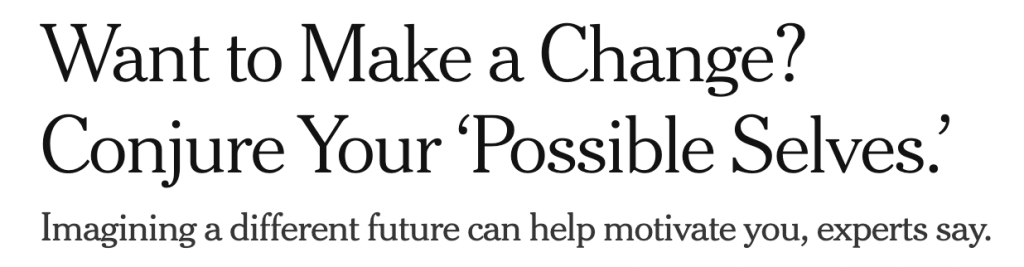
Summary of content:
So you might know that I’m trained in Cognitive Behavioural Hypnotherapy and have been practising since 2013. One of the first exercises that students learn in the diploma course is a script writing exercise, asking your client or volunteer to envision how things will be like after they have achieved their goal. So say you have a goal to become a hypnotherapist (or working out every day, a dancer, a confident and eloquent public speaker, a calm mother etc), you will then ask about a specific situation once you have achieved that, where are you, what are you doing, what are you thinking, how are you feeling, what are your body sensations like, what are your facial expression and body gestures, what are the social and financial and other impacts etc.
Doing so often motivates people to work towards their goal. It most likely increases the feel good hormones (like dopamine etc) when you see your goal achieved, and then these hormones keep you going. Of course, during the process if there’s any obstacles or any skills needed, we can use imagination or hypnosis to facilitate that too.
If you have the desire and ability to send your children to an international school, what kind of school would you send them to?
I guess many international schools we have come across are from the west, like from the United Kingdom, the States, Canada, Australia etc. And often when you look at the leadership teams of the school, you find that they are mostly white people, which is understandable, because of, I guess, the country of origin of these schools. But the thing is, these schools are now very commonly seen in everywhere else in the world. According to the international school database, there are 65 of them in Singapore, an Asian country, the map of where those schools located on the island looks something like that:

And there are 180 international schools in Malaysia, 48 in Tokyo, Japan, more than 200 in the United Arab Emirates (UAE). Some of these schools have been there for half a decade, yes maybe around or more than 50 years. Go look at their leaderships and teachers, what do you see?
I want to discuss diversity today, it’s my intention starting this writing. I want to see more diversity in those international schools, not all mostly white and/or European, in those schools. There is nothing wrong with them as individuals, they are probably all great at their job (, and it’s arguably why they are all still there).
But if you look at the students’ nationality, they are so diverse. Many of these schools have more than 80 or even 100 of students from different countries, speaking more than 60 or even 80 different languages at home! Then you look at the teachers and leaders, I can easily find like 65% of them from the UK, maybe another 15% from Australia, 10% from the US, and maybe 10% of local AND other nationalities. I made up these numbers, no school is so comfortable stating all these on their websites, they will tell you they have staff from 80 different nationals too, but the top tiers are mostly white, “and as it ‘goes down’ (to admins, cleaning staff etc), their skins get darker” – quoting a teacher I came across. Mind you, he is White. I noticed that, but was never comfortable pointing that out openly. Now I do that. I do that often, in front of other staff and students too.
Next week I’m involved in a recruitment of a boarding houseparent positions. All final shortlisted candidates are white except one, and the only exception is a European. I see the problems, I see that those who are able to present themselves so well are mostly the people from the same regions, at the same time have English as their first language, and are very familiar with what we are looking for. It’s hard for many others to be seen and get into it in the first place. But my point is not that, because that takes time to change, IF changes are wanted.
My point is, going back to my first question, is this a supply demand phenomenon? Is it because those parents who send their kids, and those kids who get to choose their schools (yes, many of them do), want their teachers to be from those regions, White, presenting themselves that way? Are parents more likely to send their kids to those schools? Are kids more likely to select those schools, than say, a school with all Asian in their leadership and teaching community?
If the answer is positive, why so?
What are the other deciding factors?
他告诉我他很嫉妒那些孩子,因为他们的父母有能力让他们上任何他们想上的学校,包括世界一流的大学,父母只需要“捐款”,然后孩子就在那里上学。
“我拼尽全力来到这里。他们呢?他们能在这上学是因为他们出生在一个富裕的家庭,拥有如此的特权!”
同样,另一个女孩告诉我“我的室友昨晚刚飞回家,为什么?因为她想家。那太烂了。我不会那样做,但我想要有那个选择。但是没有,我没有这样的选择。我很想念我妈妈,但是我还在这里。”
确实,我们真正想要的是选择的自由,但我们常常没有这样的选择。但是,当我们没有选择的时候,我们会非常努力,我们总是为任何机会做好准备,我们会充分利用我们拥有的一切,我们会最大限度地发挥我们的潜力,不是吗?
也许没有选择意味着我们过着更充实的生活,与那些在保护良好的环境中长大、总是有选择的特权,并且可以过着非常悠闲的生活(如果他们愿意 )? 他们往往有点脆弱,他们有时害怕接受挑战,也不能很好地应对挫折。 毕竟他们大部分时间都在自己的舒适区,要什么有什么,不需要面对挫折。 显然,这并不适用于每一个出生在那种家庭的孩子。 但是试着注意你周围的人,你有观察到任何规律?
然而这就是现实。 这意味着你在充分地生活、尝试、学习、奋斗,最大限度地发挥你的能力和每一个细胞。 这难道不是一种更值得过更有价值的生活,远比那种要什么有什么的生活来的更值得? 当你竭尽全力以实现目标时,感觉不是很棒吗? 这不也让你成为一个更强大、更伟大的人吗?
谁知道如果你出生在那个家庭并拥有所有这些选择,你会被“宠坏”而不会像现在这样做出任何好的选择和充实的生活呢?
也许你认为我只是想让你感觉好些,这些都很阿Q的自我安慰。 但这在世界许多地方都可以观察到,当某个少数群体在某些资源或机会(选择)上被剥夺时,他们会更加努力地奋斗,他们变得越来越强大。 这可以是某个种族、性别认同、社会经济阶层、能力不同的人等。任何一群人都是如此,我给他例子,像在马来西亚生活的少数民族…
最后他告诉我,“是的!也许这是真的。我注意到去年获得奖学金的大多数人都是 LGBTQ+,即使他们没有公开宣布,但我猜他们内心深处, 像你说的那样坚强,不像顺性别者那样生活,这很难,你知道的。但是是的,他们可以取得更大的成就”